Ever Wondered Why Open Storage Formats Like Parquet and ORC Store Data the Way They Do?
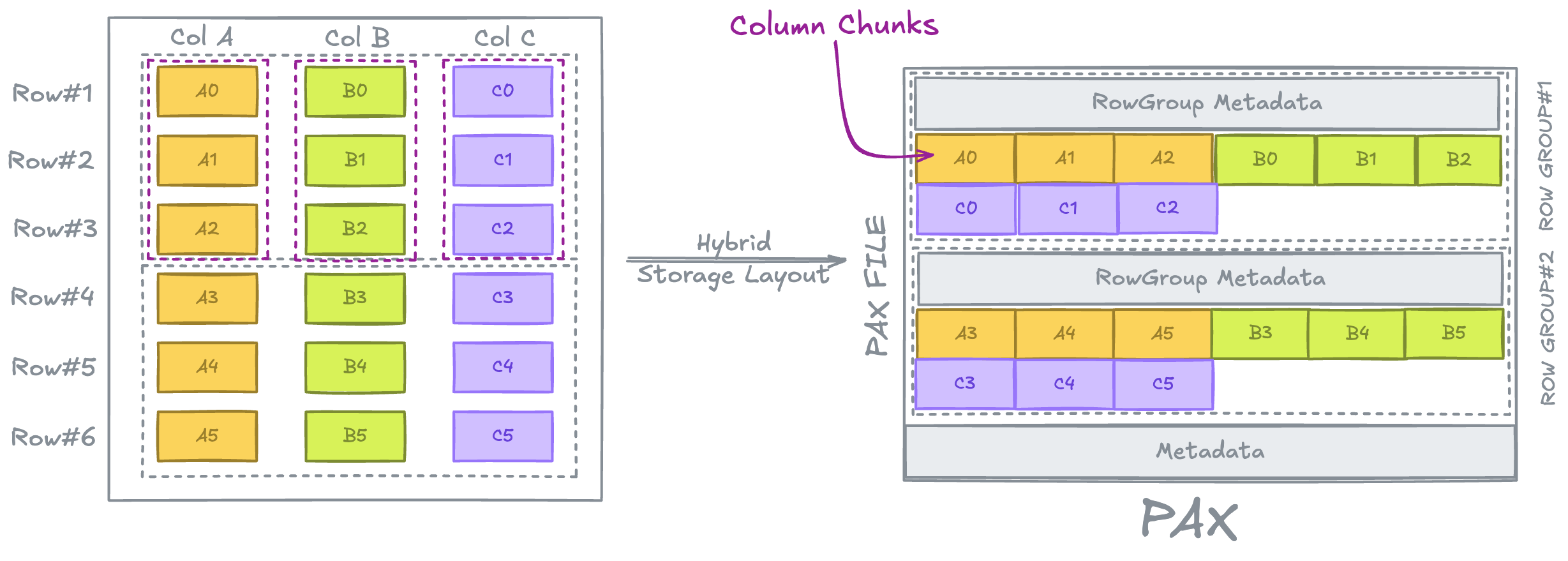
In open storage formats like Parquet and ORC, data is organized using a hybrid layout:
- Data is horizontally partitioned into Row Groups (in Parquet)/Stripes (in ORC).
- Within each Row Group, attributes are vertically partitioned and stored as column chunks.
This Hybrid Storage Format (Row Groups with Column Chunks) is called PAX (Partition Attributes Across).
But why do we need a hybrid storage format? Isn’t it better to store everything in a Columnar Format, which provides much better performance, compression, and I/O Performance? Why partition it into a row group first?
To understand the reasons, we need to understand the benefits and drawbacks of:
- Row Storage Model (NSM), and
- Columnar Storage Model (DSM)
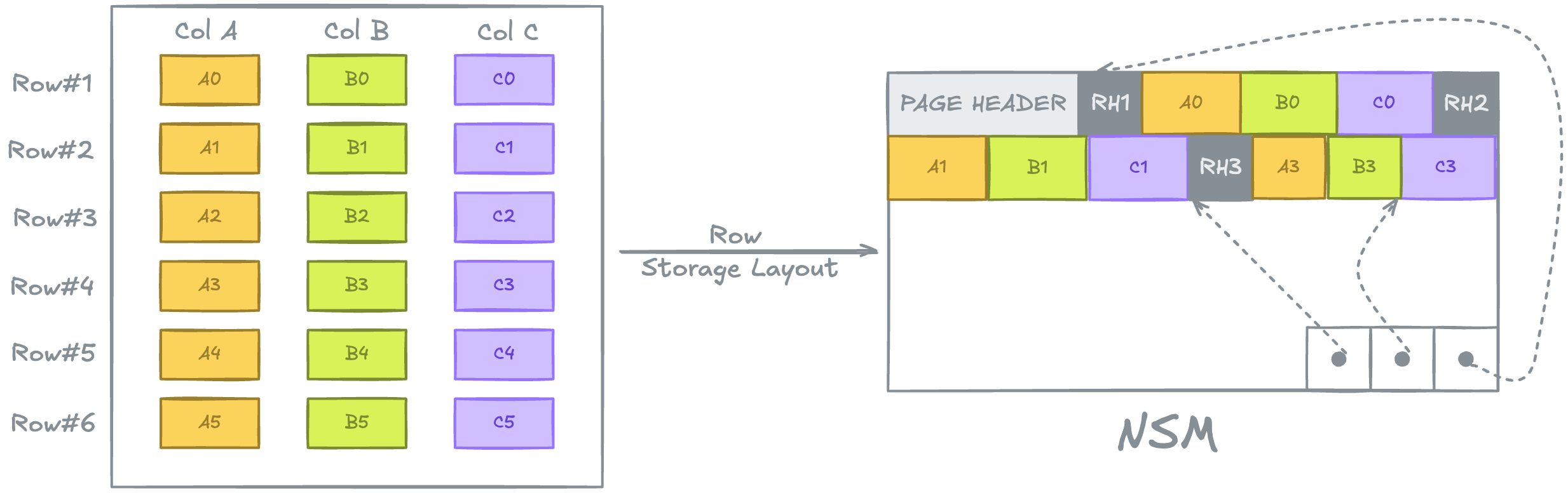
N-Ary Storage Model (NSM): Row Storage Model
- Ideal for OLTP workloads.
- Stores data in memory contiguously next to each other for all attributes.
Benefits
- Spatial Locality: All attribute/tuple values are stored contiguously in a single memory page, and don’t require additional sub-joins to make an entire row. In short, the data for all the attributes are physically close to each other.
Drawbacks
- Inefficient for analytics, fetching even a few attributes requires getting the entire row.
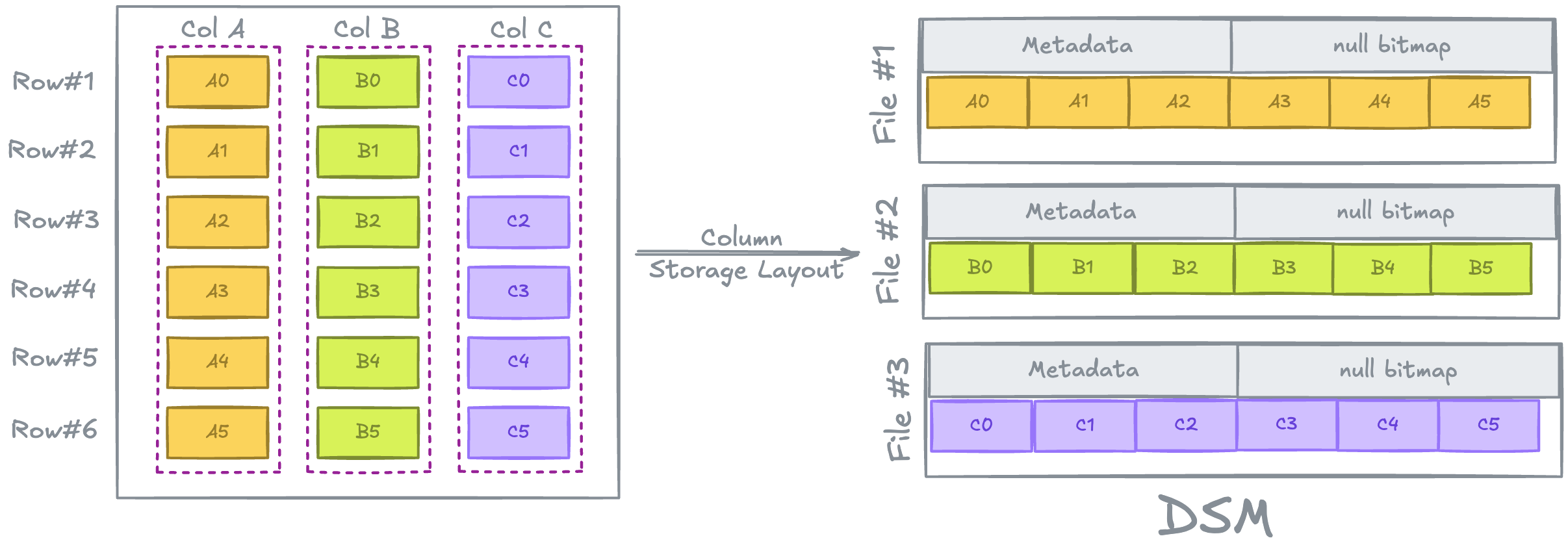
Decomposition Storage Model (DSM): Columnar Storage Model
- Ideal for OLAP workloads where read-only queries perform large scans over a subset of the table’s attributes.
- Maintains a separate file per attribute with metadata about the entire column.
Benefits
- The same data type values stored contiguously in memory result in Vectorized Processing, better compression, and I/O Performance.
Drawbacks
- To fetch multiple attributes, multiple files need to be read.
- Lack of Spatial Locality: To reconstruct a record returned by a query, all attributes must be stitched together via sub-joins.
In real OLAP workloads, queries involve multiple attributes, making a columnar storage layout inefficient. As more attributes are fetched, the cost of stitching them into a record, requiring sub-joins, rises.
Why PAX?
PAX brings the best of both storage formats:
- Columnar Storage’s performance for efficient processing and compression.
- Row Storage’s locality to reduce record reconstruction overhead.
The hybrid columnar layout (PAX) enables the query engines to use vectorized query processing and mitigates the record reconstruction overhead in a row group.
Modern data systems like Snowflake, DuckDB, and Apache Arrow leverage PAX for efficient storage and query performance.