Every time anyone discusses the Spark Architecture, it only focuses on the MASTER and WORKER Nodes. This starts to get really boring, so let’s look at some internal core components in Apache Spark.
The best part of knowing these is that next time you look into the logs, you will exactly understand what is happening when your Spark application is running, and it will be of great help in debugging the weird issues that you might face while running Spark Applications.
Map Output Tracker
A core internal components that manage shuffle map output metadata, essentially keeping track of where the outputs from map tasks are located so that reduce tasks can fetch them efficiently.
These are process-level components, i.e., exist per JVM process, a.k.a. exists per executor.
Map Output Tracker also has a Master/Worker architecture:
MapOutputTracker: Runs on the driver (also known as Master MapOutputTracker)MapOutputTrackerWorker: Runs on executors
MapOutputTracker
- Runs on the driver and holds the authoritative metadata about all shuffle map outputs for the whole application.
- After a shuffle map stage finishes, the driver collects:
- Map task indexes to corresponding shuffle server locations.
- Shuffle file identifiers.
- This tracker serves metadata to executors when requested over RPC.
- It can invalidate, update, and broadcast new shuffle output mappings when reruns or speculative tasks happen.
MapOutputTrackerWorker
- Runs on executors (worker nodes) to cache and use metadata about shuffle outputs.
- When a reduce task needs to read map outputs, it contacts the driver MapOutputTracker to get information about:
- The executor location (host/port).
- Block IDs and sizes.
- The worker tracker (MapOuputTrackerWorker) pulls this metadata from the driver and caches it locally to avoid repeated requests.
How do they work during Spark Application Execution?
- Map Stage Completion
- After map tasks finish writing shuffle data to disk (one file per reduce partition), each executor reports its shuffle output metadata back to the MapOutputTracker on the driver.
- Metadata Storage
MapOutputTrackerstores a mapping:shuffleId --> mapId --> (host:port, blockId, size)- This becomes the global view of shuffle outputs.
- Reduce Stage Fetch
- When a reduce task is scheduled on a worker executor,
- Spark looks into the local
MapOutputTrackerWorkerfor the relevantshuffleId. - If not found locally, Spark requests the shuffle output locations for the relevant
shuffleIdfrom the driver’sMapOutputTracker.
- Spark looks into the local
- If the worker tracker doesn’t have this metadata in its local cache, it:
- Sends an RPC to the driver’s
MapOutputTracker. - Gets the location metadata back.
- Stores it locally for reuse (avoids multiple RPCs).
- Sends an RPC to the driver’s
- When a reduce task is scheduled on a worker executor,
- Broadcast & Cache Invalidation
- If map outputs are LOST due to executor failure or re-computation, the driver invalidates certain map output locations in the
MapOutputTracker. - Updated metadata is then broadcast to workers.
- If map outputs are LOST due to executor failure or re-computation, the driver invalidates certain map output locations in the
Block Manager
The BlockManager and BlockManagerMaster are core components of Spark’s storage subsystem, responsible for tracking, storing, and serving physical data blocks (e.g., RDD partitions, shuffle data, broadcast variables).
Block Managers are also process-level components, i.e., exist per JVM process, a.k.a. exists per executor.
BlockManagerMaster: metadata registry on the driver.BlockManager: data store + communication layer per executor
BlockManagerMaster
- Lives only inside the driver
- Maintains a metadata registry for all blocks across the cluster:
blockId --> [(executorId, storageLevel, size)] - Does not hold any data; it stores only metadata about which executor has which block.
- Syncs updates when executors register, store, remove, or lose blocks.
- Used for scheduling locality-aware tasks (e.g., trying to schedule tasks where their input partitions are cached).
BlockManager
- Lives inside each executor
- Responsible for storing actual data blocks (RDD partitions, shuffle blocks, broadcast blocks) in memory, on disk, or off-heap.
- Handles:
- Reads/writes to local storage.
- Caching and eviction policies (LRU / size-based).
- Serving data to other executors via Netty-based shuffle or BlockTransferService RPC.
- Fetching remote blocks from peer executors when needed.
MapOutputTracker and BlockManager play a crucial role while fetching data from different nodes. Here’s a simple example of how both these work together.
How do MapOutputTracker and BlockManager work together?
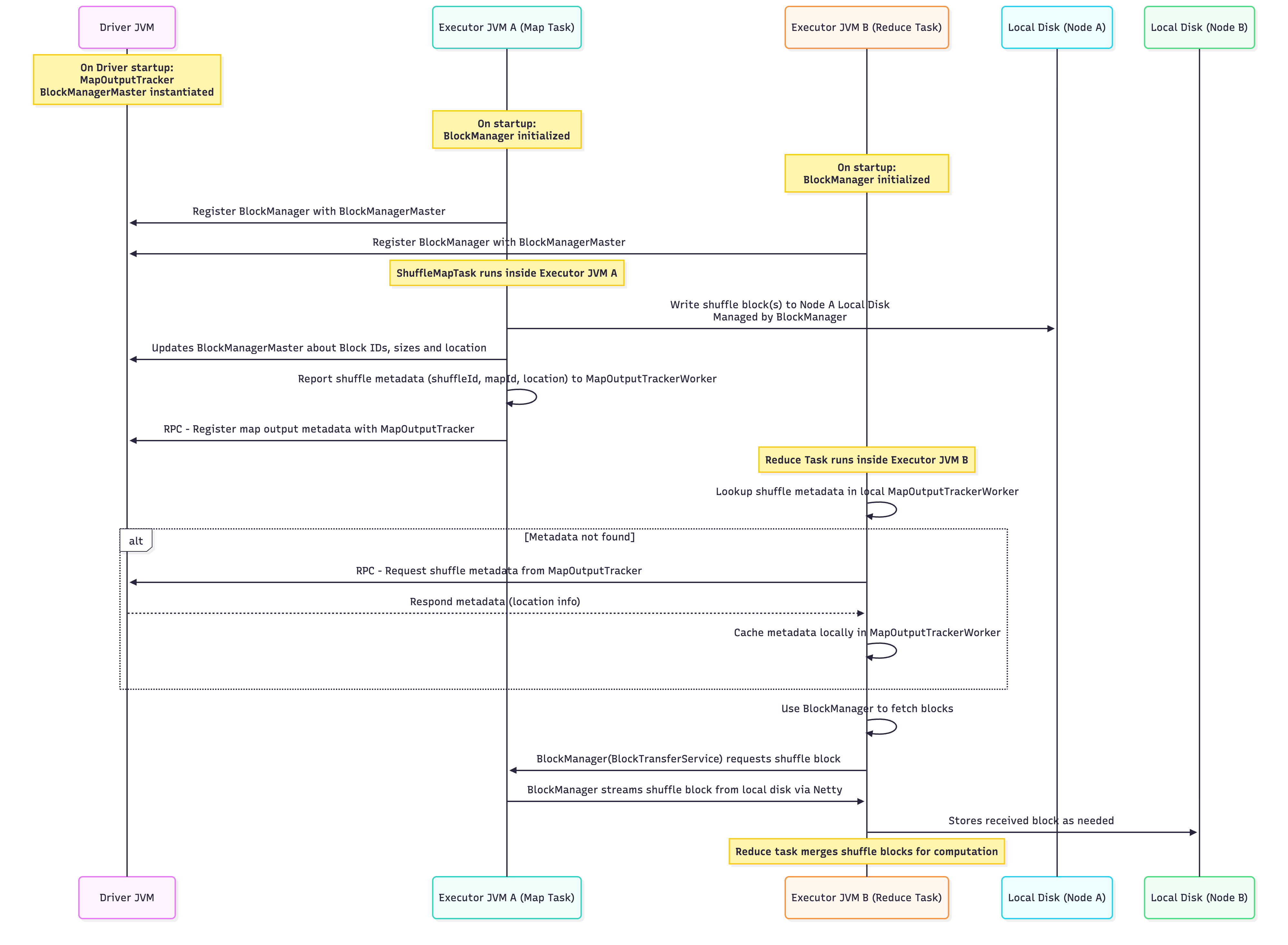
- Initialization
- During driver initialization,
MasterMapOutputTrackerandMasterBlockManagerare started - During executors initialization,
MapOutputTrackeris started and registered with the driver.BlockManageris started and registered with theMasterBlockManager.
- During driver initialization,
- Map Stage Output Registration
- Each
ShuffleMapTaskwrites shuffle data to the local disk. - Executor A’s
BlockManagermanages these physical files (registered as shuffle blocks). - Executor A informs driver’s
MasterMapOutputTrackerabout each output block’s location (host, port, sizes).
- Each
- Reduce Task Starts
- Executor B needs map outputs for its reduce partition.
- It queries its local
MapOutputTrackerWorker, which sends an RPC to the driver’sMasterMapOutputTrackerif no cached info exists.
- Metadata Lookup (MapOutputTracker’s Role Ends Here)
- The driver responds with metadata:
“For shuffleId=42, partition=3: executor on host A holds block X, host B holds block Y, etc.” - Executor B caches this metadata.
- The driver responds with metadata:
- Block Fetch (BlockManager’s Role Begins Here)
- Using the received metadata, Executor B’s
BlockManagerconnects directly to the peer executors’BlockManagers(e.g., on Executor A). - It requests the specific shuffle block files using the
BlockTransferService(Netty).
- Using the received metadata, Executor B’s
- Data Transfer
- The producing executor’s
BlockManagerstreams the requested shuffle block. - The consuming executor stores it temporarily in memory/disk via its
BlockManager.
- The producing executor’s
- Processing
- The reduce task merges all fetched shuffle blocks and computes the final results.
So both MapOutputTracker and BlockManager are at per-executor level, and store all the required details. What happens if the Executor goes down for whatever reason?!?
That’s one of the reasons, when you see FetchFailedException, i.e., when the next stage task (Reducer Stage) tries to fetch the shuffle files from the executor that has gone down.
To avoid these scenarios, during any Spark Application running with Dynamic Resource Allocation enabled, the External Shuffle Service (ESS) is used.
External Shuffle Service (ESS)
External Shuffle Service (ESS) is where Spark offloads shuffle data serving responsibilities from executor BlockManagers to an independent daemon process on worker nodes (ESS runs at the Node level and stays active until and unless the node is decommissioned).
Without ESS:
- Shuffle data (map outputs) live on executors’ local disks.
- If an executor JVM terminates (e.g., due to dynamic allocation), all its shuffle data becomes unreachable, since its
BlockManagergoes away. - This forces massive re-computation of shuffle stages whenever executors are lost.
With ESS enabled:
- A long-lived daemon process (the External Shuffle Service) runs independently on each worker node (at port 7337 by default).
- It keeps shuffle files accessible even after the executors on that node exit.
- Executors delegate shuffle read/write registration to ESS instead of serving blocks themselves.
What happens when ESS is enabled?
ESS is enabled via spark.shuffle.service.enabled=true
Updated Sequence Diagram with ESS Enabled
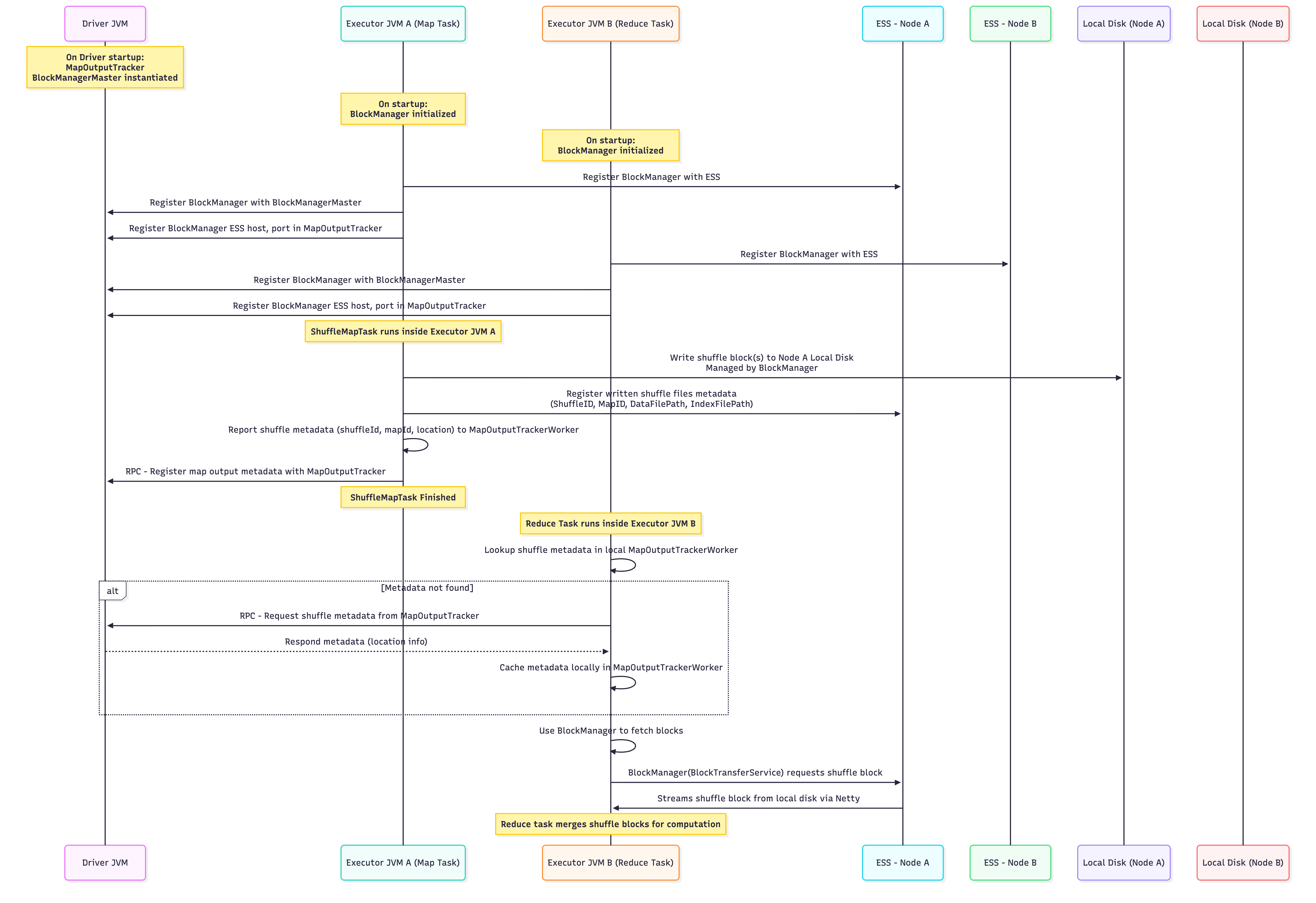
- Executor Starts
- The executor creates a
BlockManageras usual. - It also opens a connection to the ESS running on the same node.
BlockManagerregisters its shuffle service endpoint (host, ESS port) in theMapOutputTracker.
- The executor creates a
- Map Task Writes Shuffle Files
- The executor still writes shuffle data to its local disk (e.g.,
/localdir/blockmgr-*/shuffle_*). - When
ShuffleMapTaskfinishes, instead of relying solely on the executor’s BlockManager to serve those files later, it registers the file metadata with the ESS.
- The executor still writes shuffle data to its local disk (e.g.,
- ESS Registration
- The
BlockManageron the executor informs ESS about:- Shuffle ID
- Map ID
- Data file paths
- Index file paths
- The ESS stores this mapping (shuffle → local disk file path).
- The
- Executor Termination
- If the executor later exits (e.g., dynamic allocation scaling down), ESS continues running and can still serve those shuffle files.
- Thus, downstream reduce tasks can fetch data from ESS instead of a dead executor.
- Reduce Task Fetch
- Reduce tasks get shuffle metadata (host + ESS port) via
MapOutputTracker. - During fetch, their
BlockManagercontacts the ESS instance on that host, not the original executor. - ESS reads the local disk file and streams it back to the requesting executor using the same Netty
BlockTransferServiceprotocol.
- Reduce tasks get shuffle metadata (host + ESS port) via
Wait, what happens to the MasterBlockManager then?
- Not all blocks are shuffle blocks! Spark’s RDD persistence, broadcast, and many operations still rely on BlockManager-master coordination.
- The ESS is only concerned with shuffle data. The driver (via BlockManagerMaster) is still required to answer all other block status/location queries.
Below is a flowchart of the same process when ESS is enabled
---
config:
  layout: dagre
---
flowchart TB
 subgraph Driver["Driver JVM (YARN Container)"]
        MMT["MapOutputTracker<br>- Shuffle metadata registry<br>- shuffleId → mapId → location"]
        BMM["BlockManagerMaster<br>- Global block metadata<br>- blockId → executor locations"]
  end
 subgraph Exec1["Executor JVM 1 - Map Stage"]
        MOT1["MapOutputTrackerWorker<br>- Caches shuffle metadata"]
        BM1["BlockManager<br>- Writes shuffle files<br>- Registers with ESS"]
        Task1["ShuffleMapTask<br>writes to disk"]
        ESS1["External Shuffle Service<br>- Independent daemon process<br>- Serves shuffle files<br>- Survives executor removal"]
  end
 subgraph Node1["Worker Node 1"]
        Exec1
  end
 subgraph Exec2["Executor JVM 2 - Reduce Stage"]
        MOT2["MapOutputTrackerWorker<br>- Caches shuffle metadata"]
        BM2["BlockManager<br>- Fetches shuffle blocks<br>- Uses ESS locations"]
        Task2["Reduce Task<br>reads shuffle data"]
        ESS2["External Shuffle Service<br>- Independent daemon process<br>- Serves shuffle files<br>- Survives executor removal"]
  end
 subgraph Node2["Worker Node 2"]
        Exec2
  end
    MMT -. metadata sync .-> BMM
    Task1 -- shuffle data --> BM1
    BM1 -- registers shuffle files --> ESS1
    MOT1 -. RPC request metadata .-> MMT
    BM1 -- reports map output location --> MMT
    BM1 -. registers blocks .-> BMM
    MOT2 -. RPC request metadata .-> MMT
    BM2 -- fetches blocks via<br>BlockTransferService --> ESS1
    ESS2 -. also available .-> BM2
    BM2 -- provides data --> Task2
    BM2 -. registers blocks .-> BMM
    MMT -. returns shuffle locations<br>host + ESS port .-> MOT2
    style MMT fill:#b3d9ff
    style BMM fill:#b3d9ff
    style ESS1 fill:#ffe1e1
    style ESS2 fill:#ffe1e1
    style Driver fill:#e1f5ff
    style Node1 fill:#fff4e1
    style Node2 fill:#f0ffe1